Charles Schwab: A Titan of steel
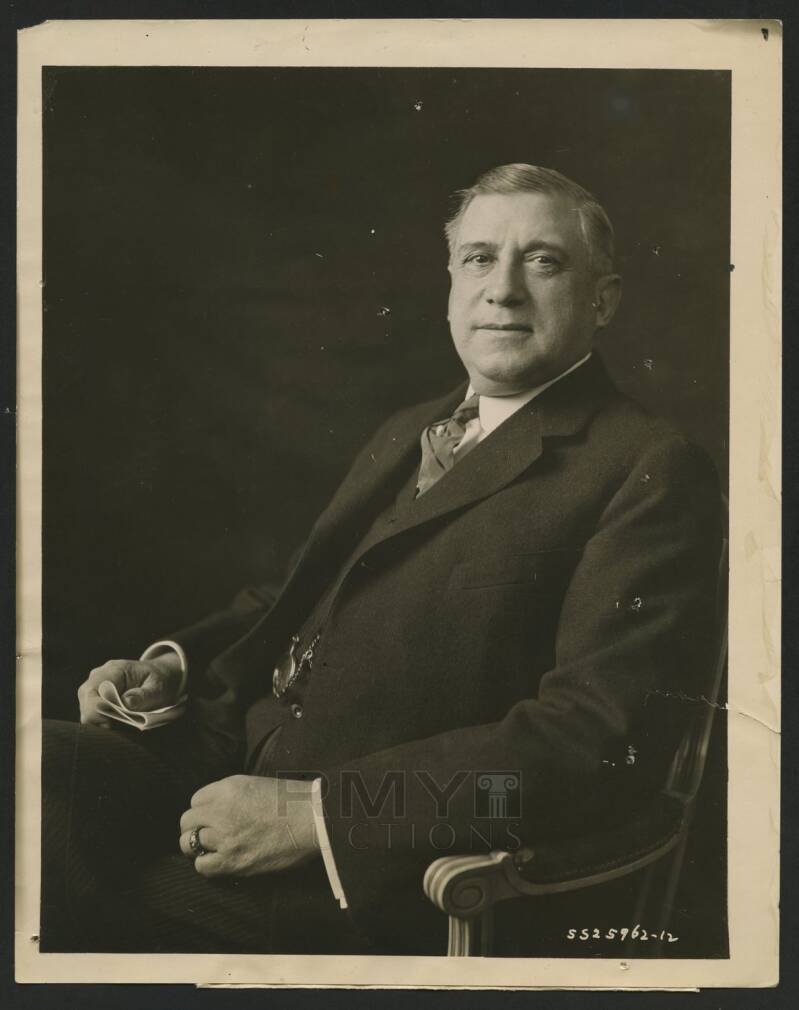
Charles Schwab today is more commonly associated with the family’s financial network. But in the early 1900s, Charles Schwab was known as one of the most successful steel executives. He led three major steel entities of the period, those being Carnegie Steel, U.S. Steel, and Bethlehem Steel. His ability to strategically manage the full range of steel production and his awareness of future constraints that would face the industry, made him one of the single most successful steel titans of America, if not the world.
At the start of the 1900s, Charles Schwab was the president for Andrew Carnegie’s steel company, Carnegie Steel. Schwab always noted that he started in steel as a laborer and was recognized for his abilities and his efforts to improve the process of steel production of all types. He was identified by Andrew Carnegie and was promoted through the ranks to eventually become president.
In 1901, Schwab met J.P. Morgan and they developed the idea to consolidate the largest steel companies into a single organization, termed a holding company at the time in the legal world.[1] With Schwab and Morgan, United States Steel (U.S. Steel) was formed by purchasing Carnegie Steel, Federal Steel, National Steel, National Tube Works, American Steel and Wire, along with several others. Schwab was named the president of the holding company which controlled two-hundred thirteen steel mills, seventy-eight blast furnaces, forty-one mines and one hundred twelve barges.[2] But Schwab was not altogether happy with his role as he was more figurehead and had very little influence or power over the production of steel. This dissatisfaction and internal competitions and conflict led to Schwab leaving U.S. Steel in 1903 to assume the helm at Bethlehem Steel.
During a journal interview, Schwab spoke of what he felt were his secrets to success in an industry as competitive as the steel industry. Schwab credited the ability of Andrew Carnegie to identify the right people within the company and provide them the growth within the organization and put them in the right positions for the company’s success. This was a skill Schwab he learned and practices. “When I look over the Bethlehem works, I decide to train up its managers as Mr. Carnegie trained his boys.”[3] At the time of this interview Bethlehem Steel Works employed 22,000 men, and he implemented a reward system that provided bonus pay to those who found improvements for the production of steel.[4]
Unlike many other steel producers, Bethlehem Steel was not impacted by unionized labor or strikes. Schwab utilized some of the techniques that he learned from Carnegie which was to pay labor for strong work.[5] Schwab stated, “the only safe business course was to pay to the labor every cent labor was worth.” As a result, wages at Bethlehem Steel were well above other steel producers and the labor there was aware of this and coveted their jobs there. As a result, Bethlehem Steel under Schwab never unionized or had a strike.[6]
Schwab’s contracts with the government to provide armor and ships grew while at Bethlehem Steel through WWI. Schwab served for one years as the director of the Emergency Fleet Corporation during the war.[7] Schwab also looked towards the future of the steel industry rather than just the short view of labor and profits. Schwab occasionally announced to committees and other groups involved in steel production that he estimated the U.S. ore fields would be depleted in sixty years or so and that there needed to be preparations for other ore depots to be pursued. He would use England as an example of exhausting their ore deposits which led to fulling importing ore from Europe. He felt that the ore fields of the steel companies were of more value than were estimated due to the limits on their production.[8]
Charles Schwab would remain at the helm of Bethlehem Steel into his later years, but with the 1920s the Great Depression started to impact on the steel industry. Layoffs and limited contracts forced great pressure on the company and started some of its decline from the peak of its economic growth in 1921. But by this point Schwab had cemented his place as one of the true Steel Titans of the era and of the steel industry. His efforts to improve the process, consolidate operations, be aware of the future challenges and the importance of labor relations all can be a credit to his success in the early 1900’s.
[1] Robert Hessen. Steel Titan. 123.
[2] Robert Hessen. Steel Titan. 123.; Unknown. “Mr. Schwab on the Steel Corporation.” 935.
[3] Unknown. “Schwab Reveals the Secrets of His Success and That of Bethlehem Steel.” 285.
[4] Unknown. “Schwab Reveals the Secrets of His Success and That of Bethlehem Steel.” 285.
[5] Unknown. “Mr. Schwab on the Steel Corporation.” 935.
[6] Unknown. “Mr. Schwab on the Steel Corporation.” 935.
[7] William R. Huber. Charlie Schwab. 165.
[8] Unknown. “Mr. Schwab on the Steel Corporation.” 935.; Huber. 95.

Create Your Own Website With Webador